

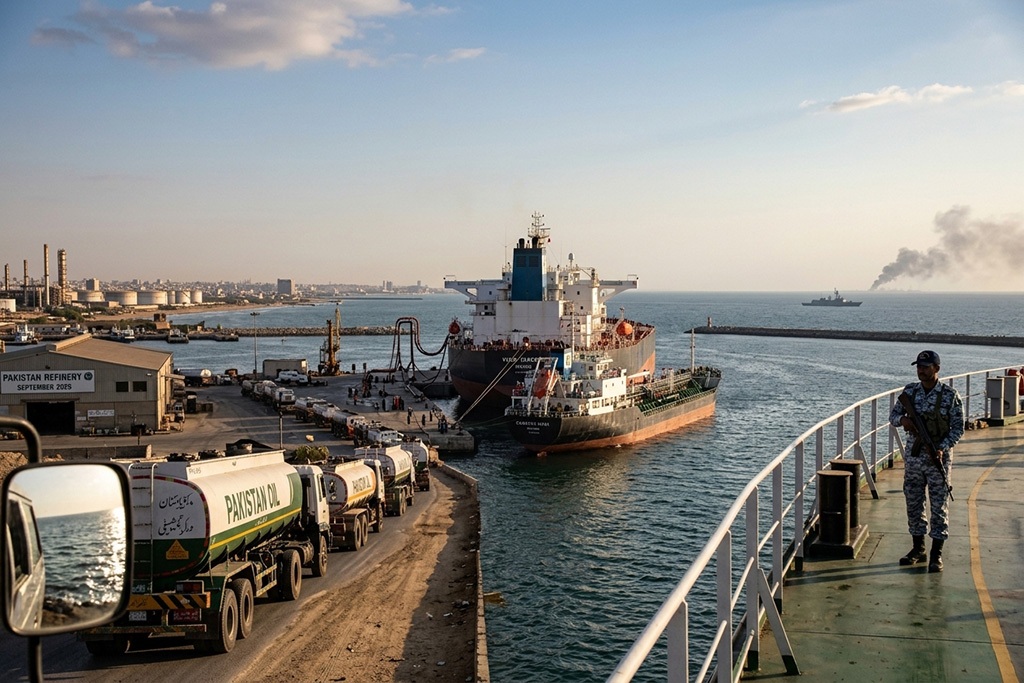
Pakistani consumers have faced severe oil shocks in recent months and are expected to confront further economic hardship as fears of countrywide oil shortages mount amid escalating tensions in the Middle East. With a major portion of Pakistan’s oil imports originating from Saudi Arabia, the closure of the Strait of Hormuz and continuous Houthi attacks disrupting Red Sea transit routes have heavily impacted Saudi Arabia’s oil exports to the region. In August, three oil cargoes arranged by the Pakistani government were halted by Yemeni Houthis until diplomatic intervention with Iran secured their release. The government has since been forced to reroute oil supplies, but rising global prices are putting immense pressure on the national economy, driving up inflation, and requiring greater dollar expenditures, forcing officials to consider diversifying crude sources away from the Gulf.
Despite the severe operational challenges, Pakistan has managed to keep its petroleum supply chain functional despite the sharp escalation in the Middle East that knocked out its primary alternative routes. When the US-Iran truce collapsed on July 8 and Iran closed the Strait of Hormuz, Pakistan initially relied on crude moving from Saudi Arabia’s Red Sea port of Yanbu via the kingdom’s East-West pipeline. However, that buffer was severely damaged when drone strikes shut down the 5-million-barrel-per-day pipeline, Houthi forces seized a strategic island at the mouth of the Red Sea, and a vessel was struck inside Hormuz. Consequently, Saudi supplies are currently out of reach due to attacks on the kingdom’s facilities, though the Petroleum Division emphasizes that the country is holding stocks for over 20 days—above the minimum buffer required by the Oil and Gas Regulatory Authority.
At domestic petrol pumps, prices have spiked rapidly following the government’s transition from weekly to daily price revisions. Between July 22 and September 20, petrol prices jumped from Rs320.73 to Rs389.14 per litre, while high-speed diesel rose from Rs367.21 to Rs424.04 per litre, representing increases of Rs68 and Rs57 per litre, respectively, in just two months. These hikes mirror global benchmarks, where physical Dated Brent stood at $125.42 per barrel and physical Dubai crossed $126 per barrel. Refined products followed the same trajectory, with Gasoline 92 RON rising 28 percent to $132.73 per barrel, while diesel touched highs of around $177 per barrel before easing.
Delivery costs to Karachi have escalated even faster, as freight rates and war-risk insurance premiums tripled or quadrupled for tankers forced to take longer routes to avoid contested waters. Despite these heavy surcharges, Pakistani consumers are still paying less for diesel than motorists in the United States, where retail diesel reached an average equivalent of roughly Rs461 per litre in mid-September. Meanwhile, regional diplomatic efforts remain fragile; a scheduled meeting between Gulf Cooperation Council states and Iran was called off, leaving Pakistan-mediated backchannel communications as the primary active diplomatic track.
To keep fuel flowing, the government has executed three critical steps. First, it maximized local refining, halting finished diesel imports since June to capitalize on local processing, where the country’s five refineries meet roughly 70 percent of diesel demand and 30 percent of petrol demand. Second, it expanded crude diversification by exploring supplies from Oman, Fujairah, Libya, the United States, West Africa, and Kazakhstan, utilizing ship-to-ship transfers from Very Large Crude Carriers parked near Sohar or Hub to bypass local port draft limitations. Third, the government implemented direct demand interventions, cutting fuel allocations for official vehicles by 50 percent for three months and deploying the Pakistan Navy under Operation Muhafiz-ul-Bahr to escort energy tankers.
Despite these measures, industry leaders warn that the coming months will present tougher obstacles, particularly regarding liquidity and petrol supplies. The Oil Companies Advisory Council has warned that Oil Marketing Companies are burdened by Rs66.7 billion in unpaid price differential claims pending since March, alongside unnotified margin increases that threaten supply stability. Furthermore, because local refineries supply only 30 percent of petrol demand, sourcing the remaining 70 percent from distant locations like Singapore incurs steep freight costs. With local refineries running at maximum capacity to produce diesel, officials acknowledge that any single break in the incoming crude supply chain could instantly trigger a national fuel shortfall during the peak harvesting season.


