

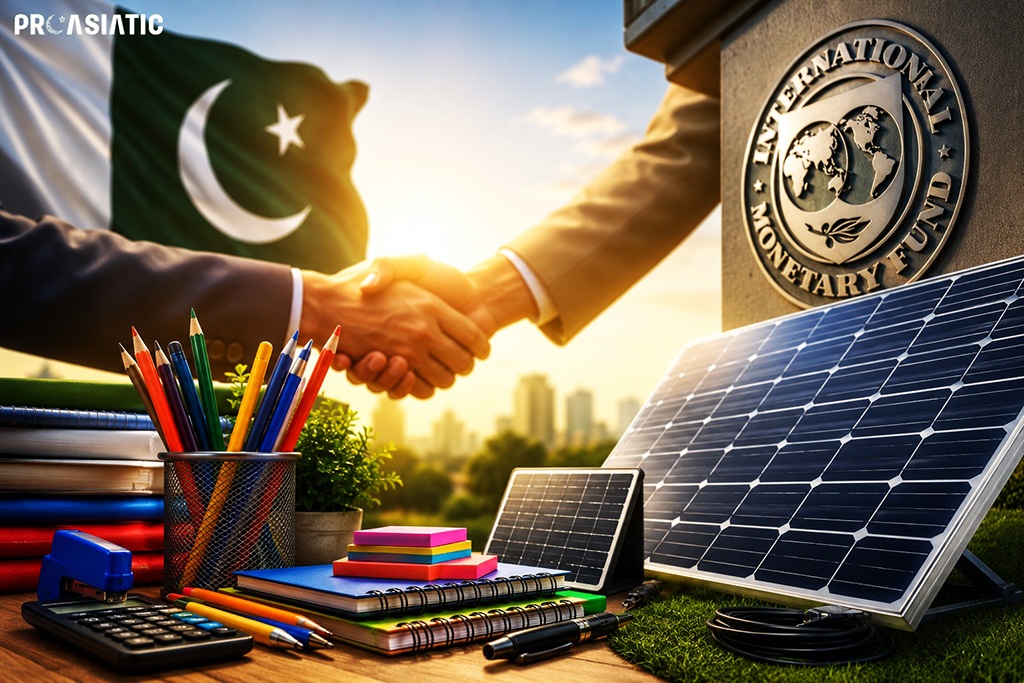
Pakistan has secured a major breakthrough in budget negotiations as the International Monetary Fund (IMF) has reportedly agreed to withdraw the proposed tax increase on solar panels and stationery items, providing significant relief to consumers, students, and the renewable energy sector.
According to sources, the development came after continuous efforts by Prime Minister Shehbaz Sharif, who urged the IMF to reconsider the proposed measures while finalizing the Federal Budget 2026-27.
Under the latest understanding, the proposal to increase sales tax on solar panels from 10% to 18% has been dropped. The decision is expected to support the country’s transition toward affordable renewable energy and encourage greater adoption of solar technology amid rising electricity costs.
Similarly, the IMF has also accepted the government’s request not to impose the proposed 18% sales tax on stationery products. The move is expected to provide much-needed relief to students, educational institutions, parents, and households already struggling with inflation.
Meanwhile, negotiations between Pakistan and the IMF are still underway regarding proposed tax incentives for the real estate sector, with both sides continuing discussions before the final budget announcement.
Sources further revealed that the upcoming federal budget will also include a special package for exporters aimed at boosting Pakistan’s exports and strengthening economic growth.
The government’s success in convincing the IMF to reconsider the tax proposals is being viewed as a significant achievement and a positive step toward protecting public interests in the upcoming fiscal year.


 has reportedly agreed to withdraw the proposed tax increase on solar panels and stationery items, providing significant relief to consumers, students, and the renewable energy sector.)