

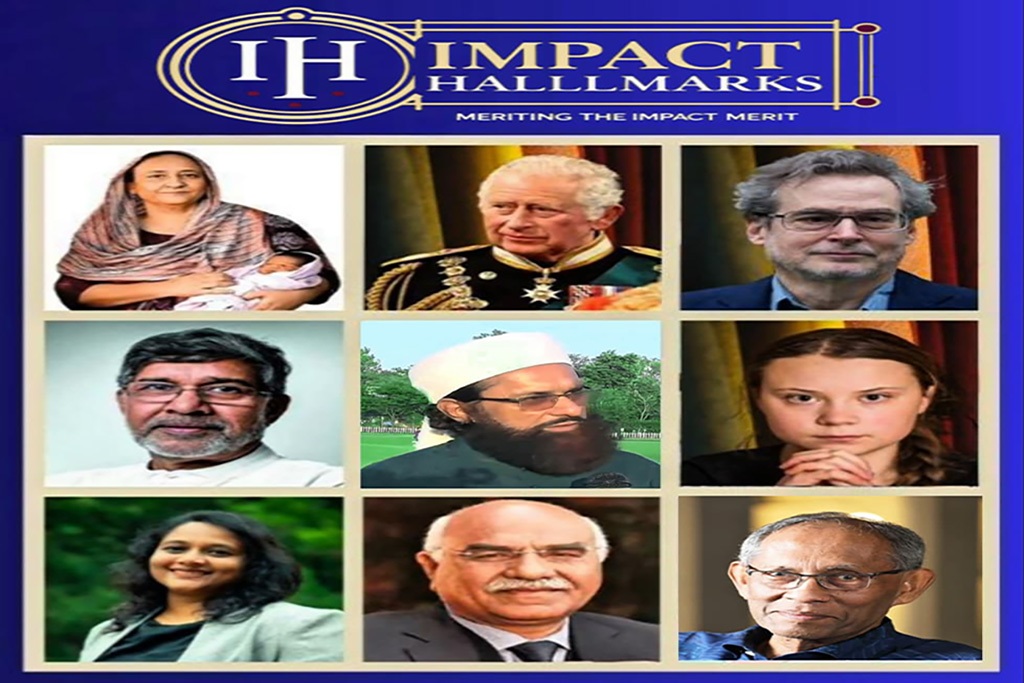
A strict and merit-bound methodology has been brought forth to lay entirely new standards of global historiography. It is for the first time in history that the individuals and initiatives are determined and recognised through such a comprehensive roadmap called 21st-Century’s First ‘Quarticentennial Merited Impacts Gazette’, a systemic way to document the most meaningful impacts of the first quarter of 21st century.
The system, developed through an extensive analytical framework known as the ‘Axiological Architecture’, is destined to identify genuine global influence by relying on documented achievements rather than popularity matrix or fame indexes.
The Gazette is designed to function as what is described as a “categorical mirror” of the modern era, capturing the defining contributions that have shaped the world between the beginning of the millennium in 2000 and the end of 2025. A selection slate comprising nearly 185 icons shortlisted out of 1.9 million notables from 195 countries has been presented to the global audience in order to to let the masses have their own say for “who did what..?…how did it impact their lives…? and what’s the merit that their contributions hold for the 21st-century’s iconicity…?
Results of Quarticentennial Merited Impacts Gazette to be announced after 04-15-2026.
Instead of focusing on public visibility, social media attention, or celebrity status, the project is built on the principle of the “Sovereignty of the Unadorned Merit”, with the resolute emblem-ethos: “Meriting the Merited Impacts” and “Valuing the Impact Value.”
In simple terms, this means that individuals and initiatives are evaluated solely on the basis of their real and undeniable contributions to humanity, knowledge, resilience, and long-term global influence.
At the heart of the evaluation process lies a comprehensive scoring mechanism called the Merited Impact Value (MIV). This system converts complex qualitative contributions — such as humanitarian service or scientific discovery — into a rigorous numerical assessment.
Every candidate or impact is examined through a 1000-point merit matrix, ensuring that the process remains systematic, transparent, and comparable across fields.
The calculation of the ‘Merited Impact Value’ (MIV) integrates four principal dimensions of merit. The first is ‘Humanitarian Impact Merit’ (HIM), which measures efforts that make lasting improvements in human welfare, social justice, and institutional compassion. The second is ‘Scientific Impact Merit’ (SIM), which recognises contributions that advance knowledge or make significant breakthroughs in science and interdisciplinary research. The third dimension is ‘Resilience Impact Merit’ (RIM), which evaluates documented endurance and leadership during major challenges, crises, or transformative historical moments. The fourth dimension is ‘Cumulative Impact Merit’ (CIM), which captures the overall influence of an individual or initiative across multiple sectors, disciplines, or geographical boundaries.
The final ‘Merited Impact Value’ (MIV) is calculated through a formula in which the humanitarian, scientific, and resilience scores are combined and then multiplied by a cumulative impact coefficient. This ensures that a contribution is evaluated not only for its individual achievements but also for the broader ripple effects it generates across society.
To maintain methodological clarity and fairness, a panel of 150 neutral assessors has been entrusted with evaluating the entries. Each candidate of iconicity is examined for the contributions through one of four analytical perspectives referred to as the ‘Centricity Focus System’. These perspectives help ensure that impacts are judged according to their primary sphere of influence.
One perspective is ‘Human-Centricity’, which focuses on contributions that transform human welfare, dignity, and social justice. The other is ‘Knowledge-Centricity’, which recognises advances that expand scientific understanding or reshape intellectual debates across disciplines.
The third perspective, ‘Nature-Centricity’, evaluates efforts aimed at protecting ecosystems and restoring planetary balance — from oceans and glaciers to mountains and deserts.
The fourth perspective, ‘Holisticity’, considers contributions that integrate several domains simultaneously and influence the broader arc of civilisation.
For analytical clarity, the Gazette also categorises recognised impacts into several thematic quadrants that reflect different forms of global influence. These include humanitarian leadership and social justice initiatives; scientific innovation and research breakthroughs; resilience and environmental stewardship; and the achievements of differently-able individuals whose perseverance and talent challenge conventional limitations.
Other categories recognise figures who embody dignified asceticism, meaning individuals whose influence stems from integrity, simplicity, and moral authority rather than material power. The Gazette also celebrates athletes whose achievements push the boundaries of human physical performance, young innovators whose ideas are reshaping the future, and a special “Legacy Memorial’ category that honours individuals whose contributions continue to shape the world even after their passing.
The evaluation itself follows a carefully structured 1000-point scoring rubric designed to ensure accuracy and documentary reliability.
Two hundred points are allocated to what is described as spatio-temporal depth — a measure of how long and how widely a contribution has influenced the world.
Half of these points assess temporal persistence, awarding marks for the sustained duration of impact throughout the years leading up to 2025. The remaining points measure spatial magnitude, evaluating whether the influence of a contribution extends locally, nationally, or globally.
A further six hundred points are dedicated to categorical rectitude and paradigm shift, essentially measuring how profoundly a contribution changes existing systems or ways of thinking. This part of the assessment asks a fundamental question: “did the effort merely contribute to an existing field, or did it redefine the very standards by which success and progress are measured..?”
To maintain credibility, these evaluations are grounded in verifiable evidence, including authenticated archives, academic publications, institutional records, or credible media documentation.
The final two hundred points form what the gazette’s axiological framework calls ‘Resonant Concurrence’, a validation layer designed to capture the broader global perception of merit. This component uses an international opinion poll to measure how strongly the public recognises and resonates with documented achievements.
Importantly, the system contains a safeguard to maintain strict meritocracy. Individuals who lack verifiable contributions or measurable merited impact, cannot score more than 200 out of 1000 points. This rule ensures that public visibility alone cannot secure inclusion in the Gazette.
Through this elaborated framework, the ‘Quarticentennial Merited Impacts Gazette’ seeks to provide what its architects describe as a ‘moral compass’ for the 21st century. By combining rigorous evidence, interdisciplinary evaluation, and global perspectives, the project aims to produce a definitive historical record of the individuals and ideas that have shaped the early decades of the millennium.
The final outcomes of the 1000-point adjudication process, verified by the panel of 150 neutral assessors, are scheduled to be aired after 04-15-2026, when the inaugural list of hallmarked ‘Merit Icons of the 21st Century’ representing the defining paradigm shifts of this era would be formally unveiled.
Quote from the Impact Hallmarks:
“Spanning the vast spatio-temporal tapestry of our era—from the towering mountains of human ambition to the deepest oceans of scientific discovery—every pulse of progress is captured here.”
“From the soaring mountains of China to the searing deserts of Africa, and from the first sunrise of 2000 to the final sunset of December 2025 — from Chen Si and Yukio Shige to Greta Thunberg and Francesca Albanese, from Stephen Soldz to King Charles — from Cristiano Ronaldo and Messi Lionel to Prince Harry and Markle Meghan; from Melanie O’Brien to Jones Aileen and Sophie Grant Crookston; from Scott Ruskan to Kailash Satyarthi — from the polymathic science icons like Systems Theorist Fritjof Capra and Arch-Researcher Aurangzeb Hafi to Fields Medallist Shing-Tung Yau — from trailblazers like Usain Bolt and Elon Musk to Asha de Vos; — from Rana Dajani to Muna Abu Sulayman and Aya Chebbi — in youngest voices from Orion Jean to Ubaida Al Fiddhah Hafiah and Ghulam Bishar Hafi — and finally, from the posthumous legacy icons like Kofi Annan and Nelson Mandela to Bilquis Edhi and Dr. Ruth Pfau — all are presented hereby to be voted by you for the Quarticentennial Merit Gazette,” reads the Impact Hallmarks ballot prologue.
“Let’s chronicle the world’s transformative journey within a resolute, merit-bound mirror of the 21st century with unbending impartiality and undeviating intellectual honesty.”
The ballot is open now for public voting at: https://www.impacthallmarks.org/#voting


